Focke-wulf fw 189 uhu
Содержание:
External links
Paste links to sources and external resources, such as:
- topic on the official game forum;
- encyclopedia page on the aircraft;
- other literature.
| Focke-Wulf Aircraft Corporation (Focke-Wulf Flugzeugbau Aktiengesellschaft) | |
|---|---|
| Fighters | Fw 190 A-1 · Fw 190 A-4 · Fw 190 A-5 · Fw 190 A-5 · Fw 190 A-5/U2 · Fw 190 A-8 · Fw 190 C · Fw 190 D-9 · Fw 190 D-12 · Fw 190 D-13 · Fw 190 F-8 |
| Tank Fighters | Ta 152 C-3* · Ta 152 H-1* · Ta 154 A-1* |
| Bombers | Fw 189 A-1 · Fw 200 C-1 |
| Export | ▅Fw 190 A-5 |
| Captured | ▃Fw 190 A-8 · ▂Fw 190 D-9 · NC.900 |
| * In 1944, the Germany Air Ministry changed new fighter aircraft designation to that of the chief designer. Kurt Tank was the chief designer at Focke-Wulf and later aircraft he designed were given the prefix of Ta. |
| Germany bombers | |
|---|---|
| Arado | Ar 196 A-3 |
| Blohm & Voss | BV 238 |
| Dornier | Do 17 E-1 · Do 17 Z-2 · Do 217 E-2 · Do 217 E-4 · Do 217 K-1 · Do 217 M-1 |
| Focke-Wulf | Fw 189 A-1 · Fw 200 C-1 |
| Henschel | Hs 123 A-1 |
| Heinkel | He 111 H-3 · He 111 H-6 · He 111 H-16 · He 177 A-5 |
| Junkers | Ju 87 B-2 · Ju 87 R-2 · Ju 87 D-3 · Ju 87 D-5 · Ju 88 A-1 · Ju 88 A-4 · Ju 188 A-2 · Ju 288 C |
| Messerschmitt | Me 264 |
| Savoia-Marchetti | ▀S.M.79 serie 1 · ▀S.M.79 B · ▀S.M.79 serie 4 · ▀S.M.79 serie 8 |
| ▀S.M.79 AS · ▀S.M.79 bis/N · ▀S.M.79 bis/T.M | |
| Trophies | ▀Wellington Mk Ic |
| Germany premium aircraft | |
|---|---|
| Fighters | He 51 B-2/H · He 112 B-1/U2 · He 112 B-2/U2 · Flegel’s Bf 109 A · Bf 109 E-7/U2 · Bf 109 G-2 · Fw 190 C · Fw 190 D-13 |
| ▀Marcolin’s C.R.42 CN · ▀Hawk H-75A-2 · ▀Yak-1B · ▀La-5FN · ▀P-47D · ▀Tempest Mk V | |
| Twin-engine fighters | Bf 109 Z · Bf 110 C-6 · Do 335 B-2 · He 219 A-7 · Ju 388 J · Ta 154 A-1 |
| Jet fighters | Sea Hawk Mk.100 · ▀G.91 R/4 |
| Attackers | Hs 129 B-2 (Romania) · ▀IL-2 (1942) |
| Bombers | Ar 196 A-3 · BV 238 · Fw 189 A-1 · Ju 288 C · ▀Wellington Mk Ic |
| Winter events | |
|---|---|
| Operation F.R.O.S.T. | |
| Pilot stars | TIS MA · J6K1 |
| Tanker stars | QF 3.7 Ram · Merkava Mk.2B |
| Sailor stars | 94 ft PT-811 · Type 1924 Jaguar |
| Festive Quest | |
| Pilot stars | M.B.152C1 · Fw 190 C |
| Tanker stars | SU-85A · T30 |
| Christmas Lights | P-43A-1 · Comet I «Iron Duke IV» |
| Festive Quest | |
| Pilot christmas toys | P-40C · NC.900 |
| Tanker christmas toys | AEC Mk II · Ersatz M10 |
| Christmas Lights | Fw 189 A-1 · KV-2 (1940) |
| Winter Holiday | |
| Pilot stages | Ki-21-I hei · Me 262 A-2a |
| Tanker stages | ▃LVT(A)(4) ZIS-2 · ▂Type 62 |
| War Thunder Fulfills Your Wishes! | |
| Pilot reward | ▂P-63C-5 |
| Tanker reward | VK 45.01 (P) |
| Holiday War Thunder Marathon! | |
| Pilot reward | I-301 |
| Tanker reward | M8A1 |
| Winter Magic! | |
| Rewards | TB-3M-17-32 · XF5F |
Usage in battles

Fw 189 A-1 parked after a mission
In most cases, you’ll be using the Fw 189 as a heavy fighter despite it being classified as a light bomber. Fortunately the aircraft can be flown like any other turn fighter in-game due to its impressive manoeuvrability which allows it to competitively combat most fighters that it encounters.
The Fw 189 is best described as a multi-purpose heavy fighter. Thanks to the light airframe, large wingspan and large elevator, the Fw 189 is an incredibly manoeuvrable plane, rivalling that of early rank Spitfires and Hurricanes. Thus, in war thunder, the Fw 189 fulfils the roles of a light bomber, ground attacker, heavy fighter, and reconnaissance in EC/ combined battles. It’s extremely adaptive to whatever role you play as (except for bombing bases), a rare trait in War Thunder lower tiers where many aircraft only excel at a single role.
The Fw 189 can start matches by either engaging enemy bombers thanks to its bomber airspawn, or engaging enemy fighter aircraft which would still be well below you when you reach them allowing for a significant advantage in initial engagements.
In Ground Battles the Fw 189 can be used to engage enemy ground vehicles using its 7.92mm MG’s and 50kg bombs, although these armaments are somewhat weak against most tanks even at lower tiers they can often provide means of gaining a few ground vehicle frags before you need to return to base, although being a somewhat large aircraft you should be careful when flying close to enemy ground units or terrain as these could knock the aircraft out if you are not careful.
While the Fw 189 can continue to fly after the loss of a single engine it will be severely under powered so a return to base in an ‘engine out’ situation is advisable.
While the pilot controlled 7.92 mm MG 17’s of the Fw 189 are somewhat weak when attacking enemy aircraft they do have a good fire rate and a good amount of ammunition (500 rpg), so if your shots can continue to hit an enemy aircraft you will shortly be able to knock out some critical components and down the enemy aircraft.
Manual Engine Control
| MEC elements | ||||||
|---|---|---|---|---|---|---|
| Mixer | Pitch | Radiator | Supercharger | Turbocharger | ||
| Oil | Water | Type | ||||
| Not controllable | ControllableNot auto controlled | Not controllableNot auto controlled | ControllableAuto control available | Combined | Not controllable1 gear | Not controllable |
Modules
| Tier | Flight performance | Survivability | Weaponry | |
|---|---|---|---|---|
| I | Fuselage repair | Radiator | Offensive 7 mm | |
| II | Compressor | Airframe | New 7 mm MGs | |
| III | Wings repair | Engine | Turret 7 mm | |
| IV | Engine injection | Cover | New 7 mm MGs (turret) | |
| This is a premium vehicle: all modifications are unlocked on purchase |
Pros and cons

Pros:
- Durable airframe overall
- Great visibility (Sim)
- Manoeuvrable at all speeds
- Effective defensive armament, fast firing MG 15s and wide coverage of tail turret
- Bomber airspawn
- Is able to fly on one engine (Although will be under powered)
Cons:
- Big cockpit is prone to pilot snipes from frontal attacks
- Mediocre offensive armament with acceptable amounts of ammunition
- Average energy retention
- Poor acceleration overall
- Very small payload
- Tail prone to control surface damages
Operational history
Called the Fliegende Auge («Flying Eye») of the German Army, the Fw 189 was used extensively on the Eastern Front with great success. It was nicknamed «Rama» («frame» in the Russian, Ukrainian and Polish languages) by Soviet forces, referring to its distinctive tailboom and stabilizer shapes, giving it the characteristic quadrangular appearance.[citation needed] Despite its low speed and fragile looks, the Fw 189’s manoeuvrability made it a difficult target for attacking Soviet fighters. When attacked, the Fw 189 was often able to out-turn attacking fighters by simply flying in a tight circle into which enemy fighters could not follow.
Design and development
In 1937, the German Ministry of Aviation issued a specification for a short-range, three-seat reconnaissance aircraft with a good all-round view to support the German army in the field, replacing the Henschel Hs 126, which had just entered service. A power of about 850–900 hp (630–670 kW) was specified. The specification was issued to Arado and Focke-Wulf. Arado’s design, the Ar 198, which was initially the preferred option, was a relatively conventional single-engined high-wing monoplane with a glazed gondola under the fuselage. Focke-Wulf’s chief designer Kurt Tank’s design, the Fw 189, was a twin-boom design, powered by two Argus As 410 engines instead of with an expected single engine. As a «twin-boom» design like the earlier Dutch Fokker G.I from 1936, the Fw 189 used a central crew gondola for its crew accommodation, which for the Fw 189 would be designed with a heavily glazed and framed «stepless» cockpit forward section, which used no separate windscreen panels for the pilot (as with many German medium bombers from 1938 onwards). Blohm & Voss, however, proposed as a private venture something even more radical: chief designer Dr. Richard Vogt’s unique asymmetric BV 141. Orders were placed for three prototypes, each of the Arado and Focke-Wulf designs, in April 1937. The Fw 189 had as part of its defensive armament design, an innovative rear-gun emplacement designed by the Ikaria-Werke: a rotating conical rear «turret» of sorts, manually rotated with a metal-framed, glazed conical fairing streamlining its shape, with the open section providing the firing aperture for either a single or twin-mount machine gun defense at the unit’s circular-section forward mount.
The Fw 189 was produced in large numbers, at the Focke-Wulf factory in Bremen, at the Bordeaux-Merignac aircraft factory (Avions Marcel Bloch’s factory, which became Dassault Aviation after the war) in occupied France, then in the Aero Vodochody aircraft factory in Prague, occupied Czechoslovakia. Total production was 864 aircraft of all variants.
Armaments
Offensive armament
 Main article: MG 17 (7.92 mm)
The Fw 189 A-1 is armed with:
2 x 7.92 mm MG 17 machine guns, wing-mounted (500 rpg = 1,000 total)
The pilot controlled guns are a pair 7.92mm MG 17 machine guns, while the individual rounds are fairly ineffective they do posses a good rate of fire allowing for a reasonable amount of damage to be dealt to targets over a short period of time.
Suspended armament
Main article: SC50JA (50 kg)
The Fw 189 A-1 can be outfitted with the following ordnance:
4 x 50 kg SC50JA bombs (200 kg total)
These 50 kg bombs are fairly weak so are mostly useless against enemy bases, but they can have their uses in ground battles against lighter ground targets
Defensive armament
Main article: MG 15 (7.92 mm)
The Fw 189 A-1 is defended by:
- 1 x 7.92 mm MG 15 machine gun, dorsal turret (450 rpg)
- 1 x 7.92 mm MG 15 machine gun, tail turret (750 rpg)
These two 7.92 mm MG 15’s have a good level of coverage from their individual turrets and also output rounds at a good rate (1050 rounds/min), they are perfectly adequate for defence against most enemy aircraft.
Тактико-технические характеристики

Схема самолёта Fw 189A-1.
Приведённые ниже характеристики соответствуют модификации Fw 189A-2:
Источник данных: Харук А., 2011, стр. 76.
- Технические характеристики
- Экипаж: 3 человека
- Длина: 12,0 м
- Размах крыла: 18,4 м
- Высота: 3,1 м
- Площадь крыла: 36,8 м²
- Масса пустого: 2 832 кг
- Нормальная взлётная масса: 3 955 кг
- Максимальная взлётная масса: 4 175 кг
- Объём топливных баков: 440 л
- Силовая установка: 2 × 12 цилиндровых воздушного охлаждения Argus As 410A-1
- Мощность двигателей: 2 × 465 л.с. (2 × 342 кВт)
- Диаметр винта: 2,6 м
- Лётные характеристики
- Максимальная скорость: 347 км/ч на 2 400 м
- Крейсерская скорость: 323 км/ч на 2 400 м
- Практическая дальность: 670 км
- Продолжительность полёта: 2,16 ч
- Практический потолок: 7 300 м
- Длина разбега: 240 м
- Длина пробега: 300 м
- Вооружение
- Стрелково-пушечное:
- наступательное: 2 × 7,92 мм пулемёта MG-17 в крыле по 500 патр. на ствол
- оборонительное: 2 × 7,92 мм пулемёта MG-81Z (турельная спарка) боекомплект 2 000 патронов
- Бомбы: 4 × 50 кг
Заказ артиллеристов
Трофейные немецкие разведчики FW-189, попавшие в руки специалистов НИИ ВВС Красной Армии, после испытаний и тщательного изучения оставили положительные впечатления. В отчетах писали, что отличная обзорность позволяла достаточно быстро обнаруживать противника, а высокая маневренность обеспечивала успешное отражение атак. При этом кормовая огневая точка позволяла без проблем обстреливать преследующие истребители. «Рама» в случае опасности спиралью уходила на малые высоты и скрывалась от преследования на бреющем полете.
Выработали в НИИ ВВС и специфические приемы уничтожения FW-189 – атака спереди с пикирования под углом 30-45°, либо снизу под углом более 45°. Заходить на «раму» было необходимо со стороны солнца или облаков. В случае обстрела экипаж немецкого самолета был слабо защищен – бронеспинкой оснащалось только кресло пилота.
Пилотировать «раму» было очень легко – это отдельно отмечали советские испытатели. Также отмечалось удобство расположения органов управления и простор в кабине. Машина могла исполнять также функции легкого бомбардировщика, способного поднять в воздух 200 кг бомб. Двухбалочная схема FW-189 оказалась удачной идеей, отлично проявившей себя на фронте, и в Советском Союзе решено было заимствовать её для создания аналогичной машины.
Во время войны в ВВС СССР не было специализированного самолета ближней войсковой разведки и артиллерийской корректировки огня. Эту функцию частично брали на себя легкий бомбардировщик Су-2 и штурмовик Ил-2. Первый сняли с производства в феврале 1942 года, и машина Ильюшина стала основными «глазами» артиллеристов на поле боя. В ноябре 1943 года под влиянием успехов немецкого FW-189 перед ОКБ Сухого поставили задачу создания трехместного двухмоторного разведчика с хорошей маневренностью и сильным вооружением.
За разработку требований к машине отвечал упоминаемый НИИ ВВС. В этой истории разработка разведчика не вышла даже за рамки эскизного проекта. До сих пор непонятно, почему машину решили не разрабатывать, но в итоге Ил-2 вынужден был выполнять несвойственную для него функцию артиллерийского корректировщика до конца войны. В случае нехватки штурмовиков артиллерия довольствовалась аэростатами.
Только в 1946 году про идею советской «Рамы» вспомнили, причем сделали это не летчики, а артиллеристы
Точнее, маршал артиллерии Николай Воронов, который написал Сталину о срочной необходимости обратить внимание на разведывательную авиацию ближнего действия. Маршал в своем обращении предложил вернуться к идее двухбалочного самолета, а также отдельно продумать концепцию корректировщика на базе геликоптера
Идею Воронова поддержали, и 10 июля 1946 года вышло постановление Совета Министров СССР о строительстве такого самолета.
Fw-189, ставший прообразом Су-12
Nocturnal recon and night fighter versions
Night Reconnaissance Group 15, attached to the 4th Panzerarmee in southern Poland during late 1944, carried out nocturnal recon and light bombing sorties with a handful of 189A-1s. These planes typically lacked the main model’s rear machine gun. Small numbers of A-1s were used in the night fighter role in the closing weeks of the war — the aircraft were modified for this new duty by having their reconnaissance equipment removed, and then fitted with FuG 212 AI radar in the nose and a single obliquely-firing 20mm MG FF autocannon in the common Schräge Musik upwards/forward-firing offensive fitment also used for heavier-airframed German night fighters, like the , but for the Fw 189; in the crew nacelle in the space where the rear dorsal gun was normally housed. The majority of the nachtjager 189s were operated by NJG 100, flying out of an airbase at Greifswald. Chronic fuel shortages and enemy air superiority over the 189s’ defence area (chiefly Berlin) meant that only a very few kills were scored by these craft.
Specifications (Fw 189 A-1)
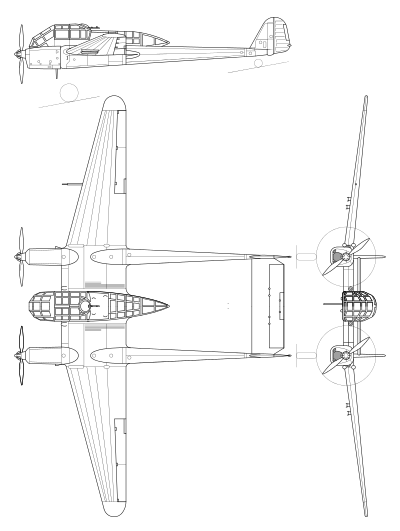
Data from Die Deutsche Luftrüstung 1933–1945 Vol.2 – Flugzeugtypen Erla-Heinkel, German Aircraft of the Second World War
General characteristics
- Crew: 3
- Length: 11.9 m (39 ft 1 in)
- Wingspan: 18.4 m (60 ft 4 in)
- Height: 3.1 m (10 ft 2 in)
- Wing area: 38 m2 (410 sq ft)
- Empty weight: 2,690 kg (5,930 lb)
- Gross weight: 3,950 kg (8,708 lb)
- Powerplant: 2 × Argus As 410A-1 V-12 inverted air-cooled piston engines 465 PS (459 hp; 342 kW)
- Propellers: 2-bladed Argus variable-pitch propellers
Performance
- Maximum speed: 344 km/h (214 mph, 186 kn) at 2,500 m (8,202 ft)
- Cruise speed: 317 km/h (197 mph, 171 kn)
- ‘Landing speed: 120 km/h (75 mph; 65 kn)
- Range: 940 km (580 mi, 510 nmi)
- Service ceiling: 7,000 m (23,000 ft)
- Rate of climb: 5.17 m/s (1,018 ft/min)
- Time to altitude: 4,000 m (13,123 ft)in 8 minutes 18 seconds
Armament
Guns:
-
- 2 × 7.92 mm (.312 in) MG 17 machine guns mounted in the wing roots, firing forward
- 1 × 7.92 mm (.312 in) MG 15 machine gun in dorsal flexible mount position firing to rear
- 1 × 7.92 mm (.312 in) MG 15 in rear cone firing to rear (optional)
Bombs:
References
Notes
- , p. 25.
- , pp. 66–67.
- , p. 26.
- , p. 172.
- Nowarra, Heinz J. (1993). Die Deutsche Luftrüstung 1933–1945 Vol.2 – Flugzeugtypen Erla-Heinkel (in German). Koblenz: Bernard & Graefe Verlag. pp. 69–72, 264–265. ISBN 3-7637-5464-4.
- Smith, J.R.; Kay, Anthony L. (1990). (7th impression ed.). London: Putnam. pp. -165. ISBN .
Bibliography
- Brown, Capt. Eric (CBE, DSC, AFC, RN) (1978). Wings of the Luftwaffe. Garden City, NY: Doubleday & Co. ISBN 0-385-13521-1..
- Green, William (1979) . Warplanes of the Third Reich (fourth impression ed.). London: Macdonald and Jane’s. ISBN 0-356-02382-6..
- .
- Kucera, Pavel (1996). Focke-Wulf Fw 189 (in Czech and English). Prague, CZ: MBI. ISBN 80-901263-6-7..
- Punka, George (1993). Focke-Wulf Fw 189 in Action (Aircraft Number 142). Carrollton, TX: Squadron/Signal. ISBN 0-89747-310-8..
- Smith, J Richard (1973). Focke-Wulf, an Aircraft Album. Shepperton, Surrey, UK: Ian Allan. ISBN 0-7110-0425-0..
- Smith, J Richard; Kay, Anthony (1978) , German Aircraft of the Second World War (third impression ed.), London: Putnam & Co, ISBN 0-370-00024-2.
- Wood, Anthony ‘Tony’; Gunston, William ‘Bill’ (1977). Hitler’s Luftwaffe: A pictorial history and technical encyclopedia of Hitler’s air power in World War II. London: Salamander. ISBN 0-86101-005-1..
History
Around 1937, the German Air Ministry wanted a short-ranged, three-seated reconnaissance plane with great visibility act as an army co-operation aircraft. Two aircraft manufacturers wanted the contract: Arado and Focke-Wulf (Blohm & Voss participated but it was a private venture). The Fw 189 prototype had an unusual twin-boom twin engine design so that there would be no engine blocking the front of the cockpit which offered maximum visibility and good speed. It was powered by two Argus As 410 engines and utilized a heavily glazed «stepless» cockpit; an all glass windscreen for the pilot to improve vision, which is similar to cockpits found on most German medium bombers. It was extremely successful not only because it was fast, but also because it was an extremely manoeuvrable aircraft. One trick utilized when a fighter came to intercept it was to start turning in a tight circle, which the pursuing fighter could not match. Later in the war, this aircraft was retrofitted for a variety of tasks which included light ground attack and a night fighter variant.
Боевое применение
В ВВС ВС Германии (вермахте) самолёт Fw 189 назвали «Летающим глазом» («Flugauge»). В советских войсках его прозвали «Рама» за характерный внешний вид. Самолёт интенсивно использовался на восточноевропейском театре военных действий, где значительно преуспел как тактический разведчик и наводчик. Также FW-189 применялся против советских партизан в Белоруссии и Украине. На Западном фронте этот тип самолёта практически не применялся.
У советских солдат существовала примета: прилетела «рама» — жди бомбардировщиков. Как правило, сразу после пролёта разведчика по обнаруженным целям наносился артиллерийский или бомбовый удар.
Несмотря на хрупкий вид и откровенно низкую скорость, Fw 189 обладал хорошей манёвренностью на больших высотах и был там весьма сложной целью для истребителей. Пилот самолёта мог легко уклониться от атаки истребителей, осуществляя горизонтальные манёвры, за которыми не могли следовать набирающие высоту истребители. Благодаря великолепному обзору и большим секторам обстрела воздушные стрелки разведчика имели все возможности сбить атакующий истребитель. Советские авианаставления рекомендовали не вести с «рамой» бой на виражах, а производить отдельные атаки, желательно из облаков или со стороны солнца.
Живучесть у самолёта также была отменная. Например, 19 мая 1942 года над Таманью на высоте около 4 тыс. метров пара МиГ-3 атаковала одиночный Fw 189А. Советские истребители поразили левый мотор необычного противника, с удовлетворением наблюдая, как после нескольких очередей он отвалился от самолёта. Уверенные в одержанной победе, «МиГи» удалились, однако тяжело повреждённая машина все-таки «доковыляла» до своего передового аэродрома. Бывало, что самолёт возвращался с задания, получив таранный удар и лишившись части вертикального оперения.
В конце марта 1945 года небольшое количество Fw 189А все ещё сохранялось в составе формирований ночных разведчиков 1.(Н)/31, 1.(Н)/12, 1.(Н)/13 и некоторых других. Они продолжали выполнять боевые вылеты практически до последнего дня войны в Европе, хотя и очень ограниченно. Так, в ночь на 17 апреля в налёте на позиции советских войск принял участие 21 самолёт из состава авиагрупп NAGr.2 и 15, шестнадцать из которых были «рамами». В налете 19 апреля участвовали два Fw 189А вместе с несколькими Bf 109 и Bf 110 из NAGr. 15. На южном участке Восточного фронта до самого финала войны действовали «рамы» из формирования 1 .(Н)/41. Последнюю потерю «рамы» в боевом вылете зафиксировали 8 мая 1945 года — это был самолёт, принадлежавший штабу авиагруппы NAGr.5.
Конструкция и производство
В 1937 году, министерство авиации Германии (Reichsluftfahrtministerium) выпустило техническое задание на тактический самолёт-разведчик-корректировщик с оптимальными возможностями обзора. Подрядчиками стали компании «Арадо», «Фокке-Вульф» и «Гамбургер Флюгцойгбау». «Фокке-Вульф» разработала альтернативную схему самолёта, названного Fw 189. Самолёт был создан инженером Э. Козелом во главе с конструктором К. Танком, с применением ряда стандартных конструктивных решений, улучшающих обзор, технологичность, аэродинамику, многофункциональность и надёжность самолёта. Было принято решение использовать два небольших двигателя «Аргус 410» французского производства, и установить их на консоли крыла. Две хвостовые балки сделали аэродинамическим продолжением мотогондол этих двигателей. Хвостовые балки оканчивалась килями, между которыми находилось горизонтальное хвостовое оперение. Центральная гондола предназначалась для экипажа. Она была каплевидной формы, практически вся остеклена. Под аббревиатурой BV 141 фирма «Бломм+Фосс» предложила свой проект самолёта-разведчика, отличающейся радикальными идеями асимметричного планера, мощным дефицитным двигателем и, кроме того, «Бломм+Фосс» значительно отстала от «Фокке-Вульф» в производстве предсерийных образцов, что стало причиной отказа от его массового выпуска. Для отработки штурмового варианта использовали первый прототип. В конце 1938 года его сняли с лётных испытаний и вернули на завод, где заменили центральную гондолу новой, гораздо меньших размеров. По сути, она представляла собой бронированную капсулу, едва вмещавшую пилота и стрелка, сидевших спина к спине. Пилот глядел вперед через крошечное бронестекло в откидываемом назад колпаке. Стрелок вел огонь из пулемёта MG-15 через небольшую бойницу с использованием бронированного визира. Модифицированный прототип получил обозначение Fw 189V1b. Обзор с места пилота был неудовлетворительным, а стрелок не видел атакующий истребитель даже в хвосте своего самолёта! В результате Fw 189V1 b вернули на завод для проведения доработок. Площадь остекления кабины пилота увеличили, а прицел стрелка заменили на амбразуру, улучшившую обзор назад, но обзор в стороны оставался неудовлетворительным. После внесения изменений Fw 189V1ta проходил испытания вместе с конкурентами Hs 129V2 и V3. Эти полёты показали, что весьма компактный одноместный самолёт «Хеншеля» представлял собой меньшую цель для ПВО, но у него обзор с рабочего места лётчика оказался ещё хуже, чем у 189-го «Фокке-Вульфа», и если управляемость Fw 189V1b была плохой, то у Hs 129 она была вовсе отвратительной. В итоге Техническое управление признало победителем Hs 129, но на этом история штурмового варианта Fw 189 не закончилась. В конце 1942 года появился своеобразный «эрзац-штурмовик» Fw189A-4, выпущенный в небольшом количестве. Эта машина сохранила остекленную гондолу разведчика, но крыльевые пулемёты MG17 были заменены двумя 20-мм пушками MG FF. Кроме того, двигатели, топливные баки и частично кабину экипажа прикрыли снизу тонкой бронёй.
Fw 189 производился в больших количествах, выбор пал на завод фирмы Aero в Праге-Высочанах, который уже в 1941 году стал основным предприятием по выпуску тактических самолётов-разведчиков. В том году бременский завод сдал 99 Fw 189А, а пражский — 151 самолёт. При этом завод «Аэро» производил также учебные Аr 96, оснащаемые теми же двигателями As 410. Производство моторов было налажено на месте — их выпускало предприятие компании Walter в Праге-Йинонице. Ещё два предприятия, находившиеся в Праге и её окрестностях, поставляли комплектующие: завод Praga концерна ČKD (во время оккупации Böhmisch-Mährische Maschinenfabrik AG) — центропланы, элероны, закрылки, тяги управления механизацией крыла, а фирма Letov (Летняны) — хвостовые балки и оперение. Первый собранный в Праге Fw 189А (Wr. Nr. 2051) был готов 12 марта 1941 году. А 4 июня самолёт лично облетал специально прибывший на завод Курт Танк. В общей сложности было построено 864 единиц Fw 189.
Variants
The main production model was the Fw 189A reconnaissance plane, built mostly in two variants, the A-1 and A-2. Unless otherwise stated all aircraft were powered by two Argus As 410 engines of 465 PS (459 hp, 342 kW).
- Fw 189 A-0: Ten preproduction aircraft for operational tests and trials.
- Fw 189 A-1: Initial production version, armed with two flexible 7.92 mm (.312 in) MG 15 machine guns in the dorsal and rear positions, one 7.92 mm (0.312 in) MG 17 machine gun in each wing root, plus four 50 kg (110 lb) bombs. It could carry an Rb 20/30 or an Rb 50/30 aerial camera.
- Fw 189 A-1 trop: Tropicalised version of the Fw 189 A-1, fitted with air intake filters and survival equipment. Conversion from A-1s.
Close up view of a rotatable, Ikaria-designed twin barrel machine gun mounting in the crew nacelle’s tail cone.
- Fw 189 A-1/U2: VIP transport version of the Fw 189 A-1.
- Fw 189 A-1/U3: VIP transport version of the Fw 189 A-1.
- Fw 189 A-2: The flexible MG 15s were replaced by twin-barrel 7.92 mm (0.312 in) MG 81Z.
- Fw 189 A-3: Tropicalised production version of the Fw 189 A-2, fitted with air intake filters and survival equipment.
- Fw 189 A-4: Light ground-attack version, armed with two 20 mm MG 151/20 cannons in each wing root, fitted with armour protection for the underside of the fuselage, engines and fuel tanks. No production known.
The Fw 189B was a five-seat training aircraft; only 13 were built.
- Fw 189 B-0: Three preproduction aircraft.
- Fw 189 B-1: Five-seat training version. ten built.
The Fw 189C was conceived as a heavily armoured ground-attack, close-support variant, in competition with the Henschel Hs 129. But its two prototypes (V1b and V6) were not satisfactory, and it was not produced.
- Fw 189D: Proposed twin-float trainer floatplane. Not built.
- Fw 189E: Prototype only, powered by two 700 PS (690 hp, 515 kW) Gnome-Rhone 14M radial engines.
- Fw 189 F-1: Re-engined Fw 189 A-1 aircraft, powered by two 600 PS (592 hp, 441 kW) Argus As 411 engines.
- Fw 189 F-2: Fitted with electrically-operated landing gear, increased fuel capacity and additional armour plating, powered by two 600 PS (592 hp, 441 kW) Argus As 411 engines.